AI Trading for Beginners: How to Start With AI Bots
AI trading uses AI to help with tasks such as screening assets, writing trading rules, or analyzing data. For a first crypto project, start with a tool that reads market data and records signals in a log. That gives you something to check before you build order execution.
Summarize with AI:
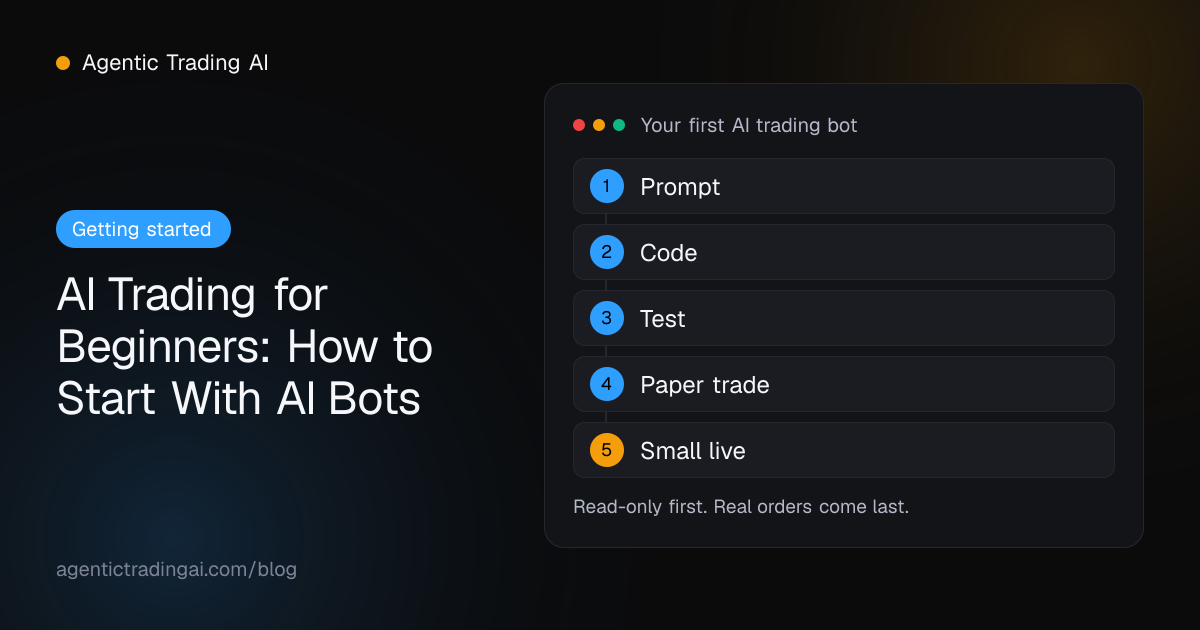
What does AI do in a trading bot?
In these projects, ChatGPT or Claude helps turn your instructions into code. That code can fetch data, check conditions, and log a signal. If you later build an execution module, the bot you run connects to an exchange or on-chain service and submits orders under the rules you set.
You may also hear the term agentic trading. It describes setups where software can perform several steps on its own, such as reading a market feed, evaluating a signal, and deciding whether to take an action. The more steps it can perform unattended, the more important it is to define what it can do and when it must stop.
How to start building an AI trading bot
- Pick one task. For example, log a Solana token when it meets a rule you can check by hand.
- Describe the inputs and output. Tell your AI assistant what data the program receives, how to handle missing values, and what it should record.
- Test the behavior. Run the code against sample data and compare the output with your expected result. Try missing fields, duplicate events, and unavailable data.
- Simulate before trading. Backtesting applies rules to historical data. Paper trading records simulated orders as new data arrives. Both help you spot mistakes before real funds are involved.
What you need to get started
- An AI assistant such as ChatGPT, Claude, or DeepSeek to write and explain the code.
- Python on your computer to run the scripts the assistant writes.
- A market data source, for example Dexscreener for Solana tokens or an exchange’s public API.
- A test environment, such as an exchange testnet or a log-only mode, before any real account.
- A few evenings to set up tools, run commands, and read what the code does.
You don’t need to be a programmer, but you do need to run the code and check its output yourself.
Example: your first AI trading prompt
Start with something read-only that you can check by hand:
Write a Python script that downloads the last 100 hourly candles for BTC/USDT from a public exchange API, calculates a 20-period moving average, and prints each time the closing price crosses above or below it. Don’t place any orders. Explain each part of the code in plain English.
Run it, compare a few signals with a chart, and ask the assistant to fix anything that doesn’t match. That loop of describe, run, check, and fix is the core skill behind every AI trading bot.
Is AI trading profitable?
AI doesn’t make a strategy profitable. It executes the rules you give it, consistently and quickly, including bad rules. Profit depends on the strategy, market conditions, fees, and risk control, and there is no guarantee. Treat early projects as a way to learn and to test ideas cheaply, not as an income source.
Common beginner mistakes
- Connecting a live exchange account before the bot has run in log-only or testnet mode.
- Giving an API key withdrawal permissions it doesn’t need.
- Pasting private keys or API secrets into a chat with an AI assistant.
- Trusting a backtest that ignores fees and slippage.
- Changing several rules at once, so you can’t tell which change helped or hurt.
AI trading terms in plain English
- Signal: the moment your rules say “this matches”, before any order is placed.
- Backtest: running your rules over past prices to see what would have happened.
- Paper trading: recording simulated trades against live prices without real money.
- Slippage: the gap between the price you expected and the price you got.
- Testnet: an exchange’s practice environment that uses test funds.
What to check before connecting an account
Review the generated code and keep private keys and API secrets out of your prompts. Give any exchange key only the permissions the project needs. Check how the bot behaves when data goes stale, an order fails, or you restart it. Fees, slippage, and order fills can make live results differ from a simulation.
Which AI trading guide should you choose?
For a practical walkthrough of finding and screening Solana tokens, start with how to trade meme coins.
- ChatGPT Trading Bot Guide for a prompt-by-prompt Solana token scanner and wallet research.
- Claude Trading Bot Guide for tracking Ethereum wallets and building a Binance copy trading workflow.
- Solana Memecoin Trading Bot Guide for token screening, wallet checks, and a Jupiter swap example. The pack includes a digital guide with prompts for DeepSeek, Gemini, and other coding assistants.
- Polymarket Trading Bot Guide for prediction-market backtesting with Claude Code. Live execution requires an API update.
Using DeepSeek? The DeepSeek trading bot walkthrough shows how to test the Solana screener with sample data.
If you’re building a wallet listener, try the Claude Code copy trading walkthrough. For a strategy based on prediction markets, start with Polymarket backtesting.
For spot crypto strategies, start by backtesting with candle data and recording the assumptions behind each modeled fill.
Frequently asked questions
Can ChatGPT trade crypto for me?
Not directly. ChatGPT can write the code for a bot, and that bot connects to an exchange with your own API key. You stay responsible for testing it and for every order it places.
Do I need to know how to code?
No, but you need to be comfortable installing tools, running commands, and reading output. The AI writes the code; you check that it does what you asked.
How much money do I need to start AI trading?
You can start with none: build the bot, run it in log-only mode, then paper trade. Only add real money once the bot behaves as expected, and only an amount you can afford to lose.
Choose your first AI trading project
Compare each digital guide, the tools you’ll need, and the one-time price.
Compare Trading Bot GuidesKeep reading
 Up nextCrypto Day Trading for BeginnersLearn what crypto day trading involves, how fees and slippage affect a round trip, and how to plan and review a practice session without risking funds.
 Up nextCrypto Trading Signals: A Verification ChecklistCheck crypto trading signals against original timestamps, market data and full result histories. Learn to spot missing evidence and common scam red flags.