Build a Crypto Copy Trading Bot with Claude Code
If you’re building a crypto copy trading bot with Claude Code, make the first version read public Ethereum activity and write a signal log. Keep the listener separate from any Binance order code. You can replay mistakes in the log without touching an exchange account.
Summarize with AI:
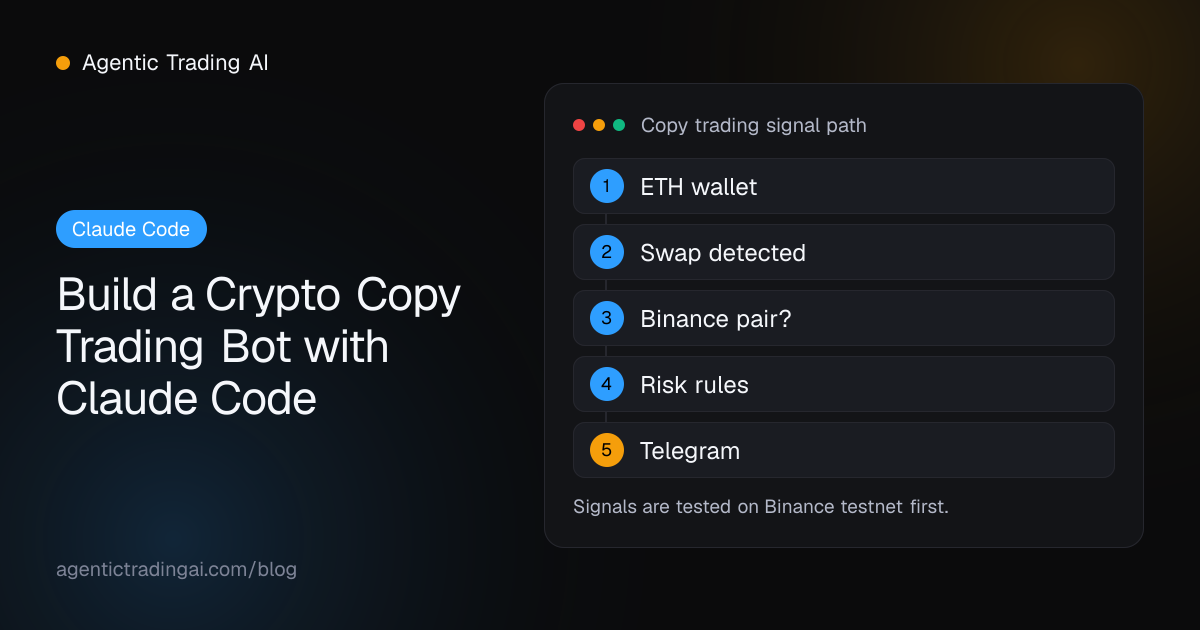
Start with a wallet event log
Save the chain ID, transaction hash, wallet address, event time, and token addresses. A successful transaction receipt tells you that a transaction ran, but interpreting its logs still takes care. Confirm whether the wallet made a swap and what it received. The Ethereum JSON-RPC reference documents the receipt and log data you can inspect.
Map on-chain assets to exchange pairs explicitly
Use a mapping you maintain from chain and token address to a supported Binance spot symbol. The chain and token address identify the asset you observed. An exchange ticker is a separate mapping decision. Treat a missing mapping as a skipped signal and log the reason. Apply the same rule when a listed pair is unavailable or the order constraints differ from your assumptions.
For example, imagine a tracked wallet swapped into a token with no corresponding Binance spot pair. The watcher should record the event, while the simulator should log that it skipped the signal. Add a second case where a token has the same symbol as a supported asset but a different contract address. Both cases should produce a clear reason in the log.
A Claude Code prompt for your first test
Create a local test module that reads saved, fictitious swap events and a mapping keyed by chain ID and token address. Emit a dry-run signal only for explicitly mapped assets. Skip failed transactions and duplicate events, and report an unknown asset as a skipped signal. Add tests for a repeat event, an unmapped token, and two tokens with the same ticker.
Check restart behavior before expanding the project
Play the same sample data twice, including a restart midway through the replay. Persist the last processed block and keep a unique ID for each event such as chain, transaction hash, and log index. The second replay should leave your signal count unchanged. Once that works, try a missing block range, a stale event, and a rate-limited response before adding any other components.
Follow the full Claude Code build
The digital guide walks through Ethereum wallet tracking, Binance integration, and Telegram alerts.
View the Claude Trading Bot GuideKeep reading
 Up nextCrypto Day Trading for BeginnersLearn what crypto day trading involves, how fees and slippage affect a round trip, and how to plan and review a practice session without risking funds.
 Up nextCrypto Trading Signals: A Verification ChecklistCheck crypto trading signals against original timestamps, market data and full result histories. Learn to spot missing evidence and common scam red flags.