Stock Memecoins vs Tokenized Stocks: The New Trend
A meme coin can trade against a tokenized stock without giving its holder any stock exposure. That distinction matters as “stonks” spreads through crypto launchpads. Here is how to read the pair and research the token behind the ticker.
Summarize with AI:
Reviewed November 19, 2026. This article explains the mechanism behind the recent launchpad trend; the cited market comparisons cover September and Q3 2026.
What is a stock memecoin?
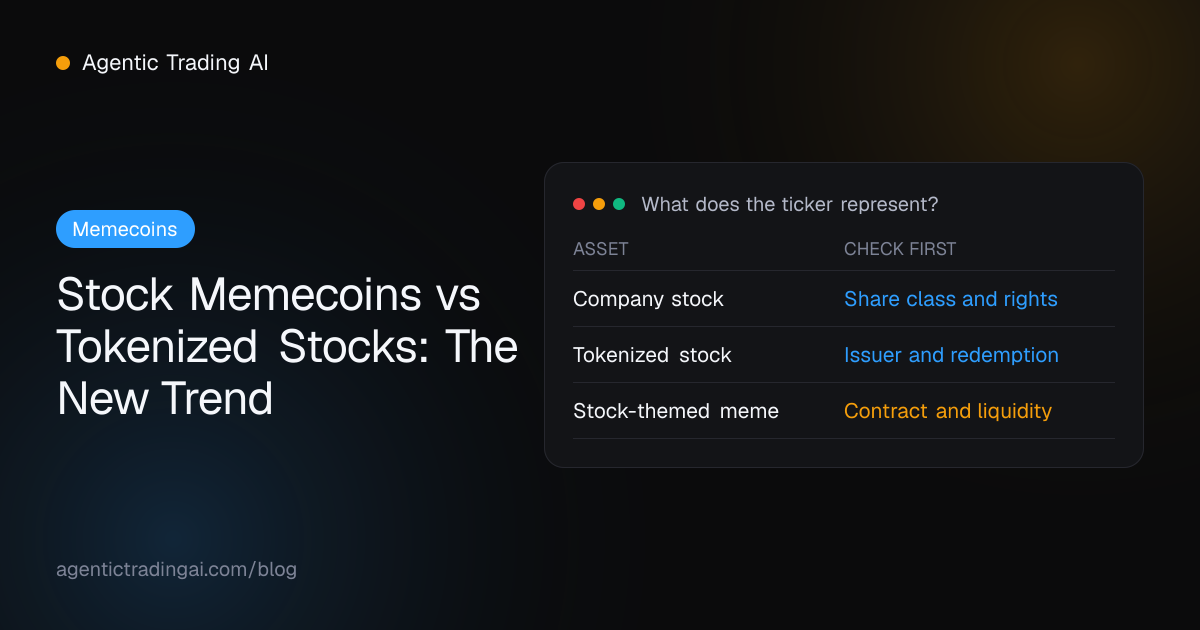
“Stock memecoin” is an informal label. It can mean a token joking about a company, a stock-market meme, or a meme token trading in a pool against a tokenized equity. Do not infer the token’s rights from its name. Start with the issuer’s documents and the exact contract address.
CoinGecko’s September launchpad research describes Pons on Robinhood Chain and StonkFun on Solana as venues for the stock-themed movement. Its daily and 30-day revenue tables produce different rankings, illustrating why one busy day cannot establish lasting dominance. Source: CoinGecko’s launchpad study, September 8, 2026.
Three assets people confuse
- The company’s stock: a security with rights defined by its share class and market structure.
- A tokenized stock product: a separate instrument whose exposure, restrictions and redemption terms depend on its issuer.
- A stock-themed meme token: a crypto token whose branding may refer to that company, with no stock rights established by the branding.
For any tokenized product, check the issuer, underlying asset, eligible jurisdictions and redemption rules directly. For the meme, check the meme’s own contract. Two assets appearing in the same liquidity pool do not share ownership rights.
How a stock-paired memecoin pool works
Bitwise’s Q4 report describes StonkFun bringing stock-paired memecoins to Solana. A pool can contain a meme token on one side and a tokenized equity on the other; a swap exchanges those two assets. Source: Bitwise Q4 2026 report, page 32.
Consider an invented example: a pool quotes MEME in STOCKX. If MEME buys 10% more STOCKX while STOCKX loses 10% of its dollar value, the combined dollar change is 1.10 × 0.90 − 1, or about −1%, before costs. A rising pair chart can therefore coexist with a falling dollar value. This is arithmetic, not a forecast or an example of an actual token.
Your scanner should save both the pair price and a timestamped dollar conversion. If it cannot verify the quote asset’s price, keep the dollar field unknown. Reusing yesterday’s conversion can make a thin pool look healthier than it is.
What to check before comparing these tokens
- Chain and contract: the same name can identify unrelated tokens across networks.
- Quote asset: confirm exactly what you receive when you sell.
- Dollar conversion: record the source and age of the quote asset’s dollar price.
- Pool depth: request a quote for the size you are evaluating instead of relying on market cap.
- Holder structure: check connected wallets and changes in concentration.
- Exit assumptions: record fees, price impact and what happens if a price feed stops updating.
This extends the workflow in our DEX Screener API tutorial. The key change is to preserve quote-token information all the way through the pipeline instead of treating every pool as a SOL or stablecoin pair.
A prompt for adding quote-asset checks
Review my read-only token scanner. Preserve chain ID, base token,
quote token, pair address and observation time for every pool.
Separate price in the quote asset from price in USD.
If a conversion is missing or stale, mark it unknown and exclude it
from dollar-based rankings. Add sample cases for a falling quote asset,
duplicate tickers and two pools for the same token. Do not add signing
or order execution.
Use invented fixtures to check the arithmetic, then compare several rows against the original data source. Ask the assistant to explain every conversion. Automated tests of known inputs are more useful here than a visually impressive profit dashboard.
Should this replace ordinary Solana memecoin research?
It adds another field to the research process. Liquidity, contract permissions, holder concentration and data freshness still matter. Keep these tokens in a separate watchlist until your scanner handles their quote assets correctly. For the wider context, read our November memecoin trend roundup.
Start with the Solana scanner workflow
Learn the prompt-based process for screening tokens and checking wallets in the Solana digital guide. Stock-paired assets need additional quote-asset checks beyond the guide’s core workflow.
See the Solana digital guideKeep reading
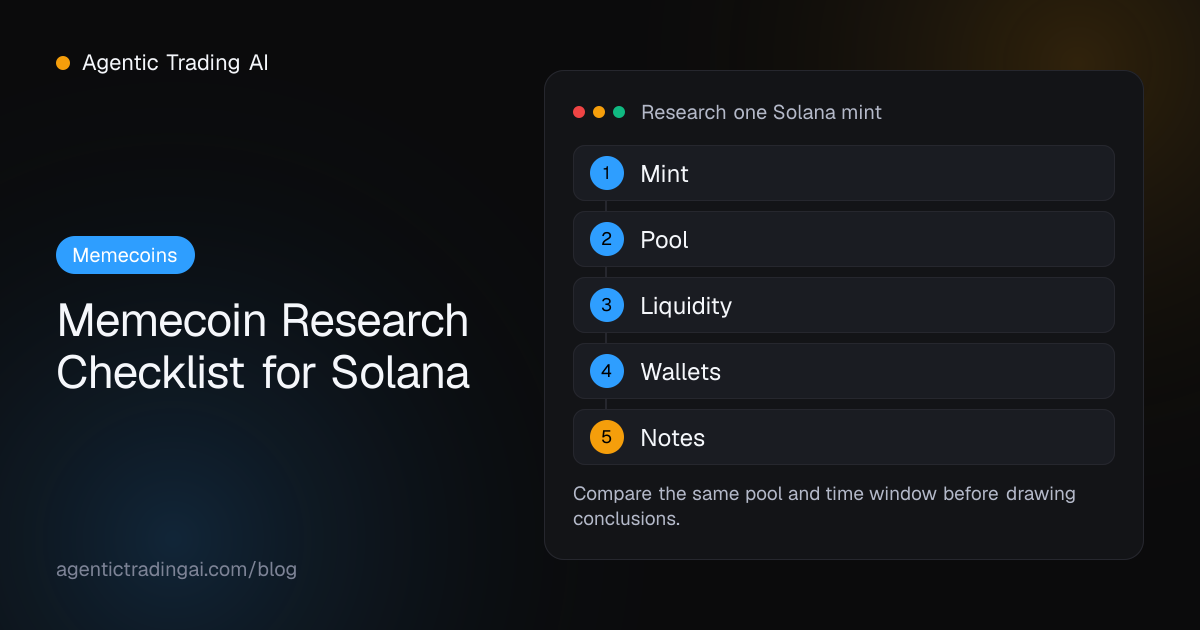 Up nextMemecoin Research Checklist for SolanaUse a read-only Solana memecoin research checklist to verify a mint, compare charts across platforms, and document liquidity and wallet activity.
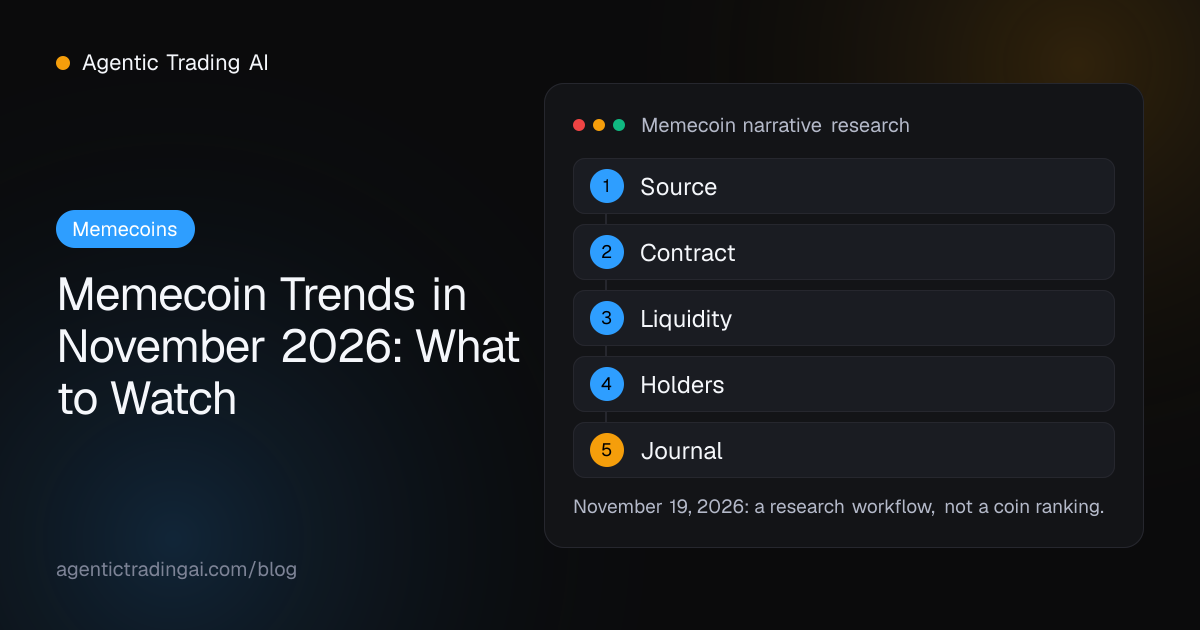 Up nextMemecoin Trends in November 2026: What to WatchExplore November 2026 memecoin narratives: AI agents, stock-themed tokens and launchpad competition, with a practical checklist for researching each trend.